Neat Is Not the Same as Ready to Use
A ready-to-use communal room puts useful things where tasks happen, helping people begin without searching, rearranging furniture or asking who moved them.
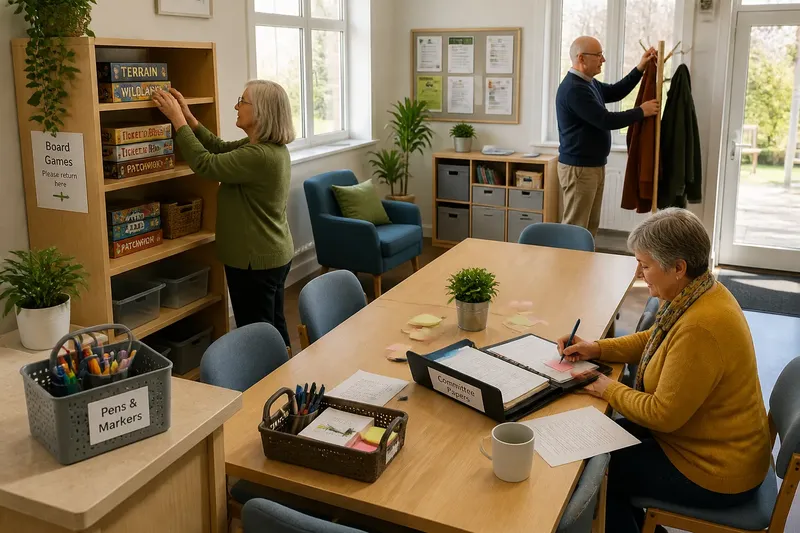
The common mistake in caring for a communal room is treating a tidy surface as proof that the room is ready. A ready-to-use communal room puts what people need near the activity, rather than arranging everything to look orderly while leaving someone unsure where to put a coat, find a pen or return a board game.
That mismatch costs time and goodwill. Someone arrives early to set up, opens cupboards, shifts furniture, then puts everything back according to a system known only to the person who tidied last. A room can look impeccable and still make ordinary tasks feel like a small negotiation.
Instead of asking whether everything looks uniform, ask what the next person is likely to do and what they will need within reach. A craft group, a drop-in advice session and a residents’ meeting do not need the same objects in the same places, even if they share one address.
Start with the task, not the appearance
Task-ready placement means storing an item close to the activity that uses it, with enough visual information for someone unfamiliar with the room to recognise it. It does not mean leaving every possible object out. It means reducing the awkward gap between deciding to begin and having the materials to begin.
For an informal meeting, a tray with pens, blank paper and sticky notes near the table may be more useful than a sorted stationery cupboard across the room. For a sewing circle, a labelled basket of shared scissors and tape measures near the work tables may make more sense. The useful test is whether people can start, continue and finish without needless searching.
Follow the sequence of actions: enter, put down a bag, find a chair, collect materials, use them and return them. If the room supports that sequence, a few objects can stay visible without making the whole space feel cluttered.
Choose storage for the room’s pattern of use
Sort the room by its main pattern of use, then place shared items to support it. If several patterns occur, give the most frequent or least flexible activity a dependable home, while keeping occasional needs portable.
- If one activity happens regularly: check whether its everyday materials are together near the work area. If a language group’s whiteboard markers and eraser are scattered, put them in a labelled caddy beside the board; if they are already together and accessible, keep that arrangement.
- If activities change from day to day: check whether a fixed station would obstruct another group. If it would, use a portable kit such as a lidded box of drawing materials and return it to a named shelf; if not, keep only the shared essentials at a fixed station.
- If groups arrive without a regular organiser: check whether essential items can be identified without help. If sign-in sheets, pencils and spare paper are hard to find, place them in a labelled tray near the entrance; if they are already obvious, avoid adding a second storage point.
- If groups share equipment: check whether communal supplies are distinct from group-specific ones. If ownership is unclear, mark a shared shelf and give each group a separate container; if the distinction is already clear, retain the current locations.
- If storage is limited: check which supplies are used together and where they are needed. If frequently used items are kept far from their task, give them a compact labelled box nearby; if moving them would block another activity, keep them in a clearly marked shared cupboard.
- If a room has delicate or private materials: check whether open access could cause damage or expose information. If it could, use a suitable closed or controlled container and label its purpose; if not, keep durable everyday supplies visible and reachable.
Imagine a residents’ room used for a weekly board-game group and occasional committee meetings. The starting point is mixed game boxes on a high cupboard shelf, with meeting papers loose near the table. Move the games together to an accessible shelf, add a simple return label, and place the papers in a separate folder by the table. The expected result is that players can choose and return games without unpacking unrelated boxes, while committee papers remain distinct; the trade-off is that the shelf must stay available for the games rather than general storage.
Keep useful things visible without displaying everything
Visibility is a tool, not a decorating principle. A labelled basket or open tray can help people spot materials, but leaving every supply on a counter turns a working room into a permanent setup. Keep out items used often enough to justify their place; store occasional or delicate materials in a labelled container nearby.
Labels should use words people actually use. “Pens and markers” is clearer than an internal category such as “stationery, assorted”. Where several containers look alike, a large word on the front can save people from opening each one. A picture may help where readers use different languages or have varied literacy needs.
Do not make a label do the work of a sensible location. A sign that says “scissors” on a cupboard across the room explains where they are, but does not make them convenient to collect and return. Put items close to their task where practical, and use labels to clarify, not compensate.
Decide what should stay out and what should be put away
The right amount of visible equipment depends on how often it is used, whether it is safe to leave accessible and whether it obstructs other activities. Shared pens and a whiteboard eraser may belong within easy reach. Delicate craft materials, private records or specialist tools may need controlled storage instead.
For each item, check whether it supports a regular task, whether its purpose is obvious, whether its location blocks another activity, whether people can return it easily and whether open access could create a privacy, damage or safety concern. If it is used often and safe to share, keep it accessible; if it is rarely used, obstructive or sensitive, store it in a clearly identified place with appropriate access.
The aim is not to eliminate cupboards. It is to prevent the cupboard from becoming a puzzle.
Keep the room workable between activities
Shared rooms often fail at the handover between groups. One group may leave a table arranged for its own task, while the next inherits a layout that takes time to undo. A simple return routine helps when it reflects the room’s actual uses rather than an imagined standard of visual neatness.
Agree on observable conditions: shared materials returned to marked containers, surfaces clear enough for the next activity, and movable furniture left in a known starting arrangement. If a group needs a different layout, it can reset the furniture when it arrives. Identical rows of chairs are not useful if the room’s regular work happens around tables.
A short note near storage can clarify what belongs where. “Return games to this shelf” answers a useful question. A page of rules about every possible item may be ignored, which is a rather efficient way to produce more paper.
How do people keep a shared room ready for use?
Should shared supplies be kept in open storage?
Open storage suits familiar, durable items that people use often and can return easily, such as ordinary pens or board-game boxes. Use closed or controlled storage for sensitive, fragile or specialist materials, and make the container’s purpose clear.
How can several groups share the same equipment?
Keep common supplies in a clearly identified shared area and give group-specific materials separate containers or shelves. A simple return location helps distinguish shared equipment from items that belong to one group.
What belongs on a room reset list?
Include actions that prepare the space for its next likely use: returning frequently used items, clearing working surfaces and restoring the agreed furniture arrangement. Make each action visible and easy to complete, rather than asking people to make the room look generically perfect.
When should the arrangement be reviewed?
Review it when people repeatedly search for the same item, ask where something belongs or leave materials beside the activity rather than returning them to their official home. Those recurring signs suggest that the arrangement may not match the way the room is being used.
Let repeated behaviour guide small changes
Watch for practical clues: a chair used as a shelf for materials, a drawer opened and shut several times before the right item appears, or supplies repeatedly left beside the activity. These patterns may show that storage is too distant, a label is unclear or a supposedly shared item is not actually shared.
Change one arrangement at a time where possible. Move a frequently used basket nearer its activity, make its label clearer or give a portable kit a defined return spot. Then notice whether people can complete the task with less searching and whether the new position causes trouble for another group.
For a communal room, readiness is not a finish imposed on every object. It is a practical arrangement: the next person can tell what is available, reach what their task needs and return it without needing a private tour. When you review a ready-to-use communal room, look at what people actually do before changing where things belong; their habits are a better guide than a tidy photograph.