Printed Signs or a Person at the Door? Choosing How to Welcome People
Printed signs or a person at the door can orient guests in different ways; choose the right mix to make arrivals clearer without adding clutter.
The common mistake with printed signs or a person at the door is choosing one by habit, then asking it to solve every arrival problem. A sign cannot notice someone hesitating, while a greeter cannot be in two places at once; the cost is a guest left uncertain about where to go or whom to ask. Decide what an arriving person needs to know, then match the welcome to that need.
Start with the first decision a guest must make
Stand outside the room or building and follow the arrival from the entrance. Identify the first point where someone must choose: a corridor, a staircase, a lift lobby, a reception desk or a door that could lead to more than one room. A useful welcome answers that decision before the visitor has to guess.
Write down the essential information in order: where the gathering is, whether to enter or wait, and what to do if the room is not obvious. Keep secondary details, such as the full programme or names of organisers, elsewhere. The first message should do one job cleanly.
Say you are arranging a reading group in a community hall whose entrance opens onto two corridors. Imagine a newcomer arriving while the organiser is inside setting out chairs. A printed arrow naming the room can guide that person to the right corridor; a greeter becomes more useful at the room door, where they can confirm the group and answer a question.
Use a printed direction for stable, simple information
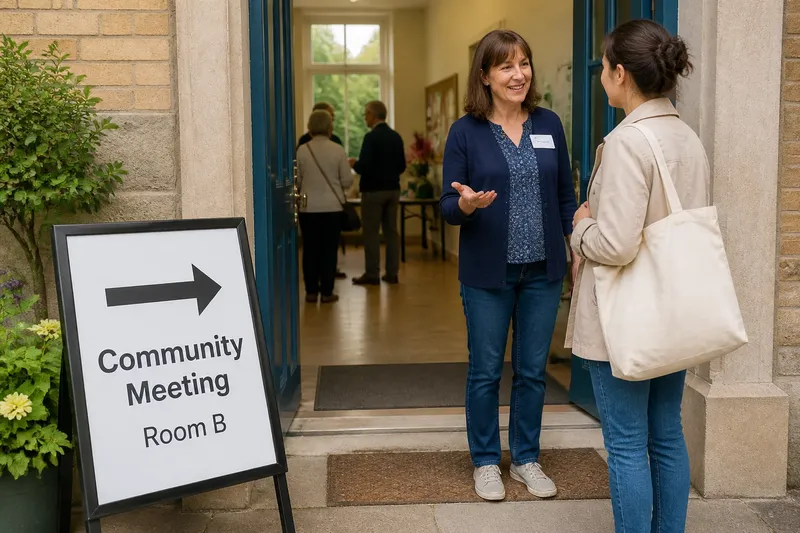
A sign works well when the instruction is brief, fixed and useful to several people at once. “Community meeting, Room B” or “Please wait here” can be read at a glance without requiring a conversation. Place the message before the decision point, not after it; a sign at the destination cannot help someone find the destination.
Use large, legible lettering, strong contrast and ordinary wording. A sheet printed in black on white paper may be clearer than a decorative poster with pale text, a logo and several lines of welcome. Put the direction at a height and angle where someone approaching can see it without turning around or stepping into a queue.
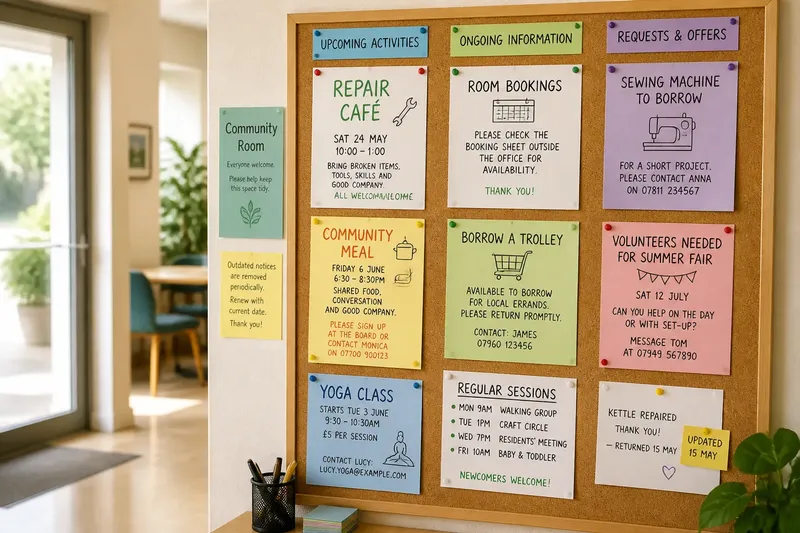
Keep the sign specific to the occasion and remove it when it no longer applies. An old arrow pointing to last week’s meeting is not atmosphere; it is a small, laminated act of sabotage. If several signs are needed, make their wording and visual style consistent so visitors can tell which instructions belong together.
Choose a person when the arrival needs judgement
A person at the door is more useful when guests may need different answers, when the entrance is not self-explanatory, or when someone may benefit from a quiet offer of help. A greeter can confirm that a visitor has found the right gathering, explain where coats can go, or point out an accessible entrance without making every instruction public.
Give the greeter a clear place to stand that does not obstruct the doorway, and make sure they know the room name, the host’s name and what to do when they cannot answer a question. A simple opening such as “Hello, are you here for the craft group?” gives the visitor room to respond rather than requiring them to announce why they have come.
Human help depends on being present and recognisable. If the organiser is likely to be carrying equipment, speaking to a venue manager or welcoming another person, do not treat them as a permanent fixture at the entrance. Ask someone to cover the door, or use a sign for the basic direction and reserve a person for questions.
Match the welcome to the gathering
Consider the likely arrival pattern. A group where everyone arrives within a short window may benefit from a greeter who can settle newcomers and keep the entrance calm. A drop-in session with people arriving at varied times may need a clear sign at the entrance, with a host visible inside or available to answer questions.
Consider privacy as well as convenience. If visitors might not want to explain their reason for attending to a stranger, a sign can give them a discreet route to the room. If the gathering has several activities in adjoining spaces, a person can ask which activity someone is looking for and direct them without making the sign carry a paragraph of options.
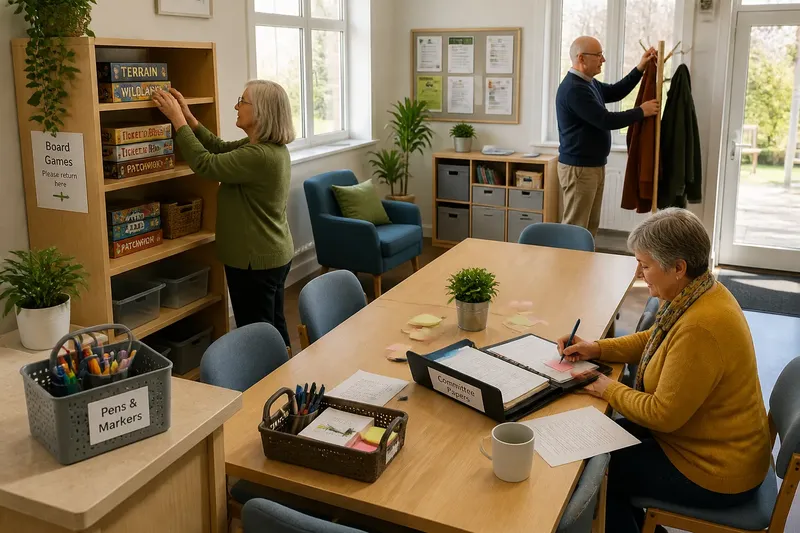
Think about the space itself: a noisy lobby may make spoken directions difficult, while a dim or visually busy entrance may make a printed notice hard to pick out. The right choice is the one a guest can actually use there, not the one that looks most polished in the organiser’s notes.
Prepare a combined welcome without clutter
Often the best arrangement is a short sign for the basic direction and a person near the destination for reassurance. Keep the sign’s message limited to what someone needs before entering. Let the greeter handle questions that depend on the visitor or the moment.
- Walk the arrival route and mark each point where a guest must choose.
- Write one short instruction for each point that needs a sign.
- Check that the wording names the event or room clearly, rather than relying on an unexplained arrow.
- Choose a greeter only if someone can stay at the entrance and knows what help to offer.
- Remove notices for past events and any signs that compete with the current direction.
- Ask someone unfamiliar with the arrangement to follow the route and say where they would go next.
When a venue’s access arrangements or signs are governed by its own instructions or local requirements, follow those directions rather than improvising a route.
Check the welcome from a guest’s point of view
Before the gathering, approach the entrance as if you have never visited. Can you tell which room is being used? Is the sign visible before the relevant turn? If there is a greeter, can you identify them without having to interrupt a conversation?
Make one adjustment at a time. Move a notice into view, shorten its wording, or shift the greeter to a less obstructive position. Then look again from the approach. A welcome should reduce uncertainty, not add a second puzzle about which instruction to follow.
Which welcome works best for these situations?
Is a printed sign enough for a first-time visitor?
It can be, if the route is straightforward and the sign identifies the destination before each necessary choice. If the entrance is confusing or the gathering has several possible destinations, add someone who can respond to questions.
Should the greeter stand outside or inside the room?
Place them where visitors are most likely to pause, while leaving the doorway clear. If people can find the room easily but may be unsure whether they have arrived at the right group, just inside the room may be the more useful position.
What should a welcome sign say?
Name the gathering or room and give the next action, such as entering or waiting. Leave background information and a long list of reminders for a notice in the room, where visitors can read it without blocking the route.
What if nobody can stay at the door?
Use a clear, well-placed direction for the parts of the route that require decisions, and make the host’s location apparent once a visitor reaches the room. Avoid promising personal help at the entrance if nobody will be there to provide it.
Make the last check before guests arrive
Printed signs or a person at the door are not competing symbols of welcome; they are different ways to remove uncertainty. A sign offers the same stable instruction to everyone, while a greeter can respond to the person standing in front of them. Use the simpler option where the route is clear, and add human help where the space or the gathering calls for judgement.
Just before opening, check that the notice still names the right room and that the person welcoming guests knows where to direct them. That small final check is often more useful than adding another sign.